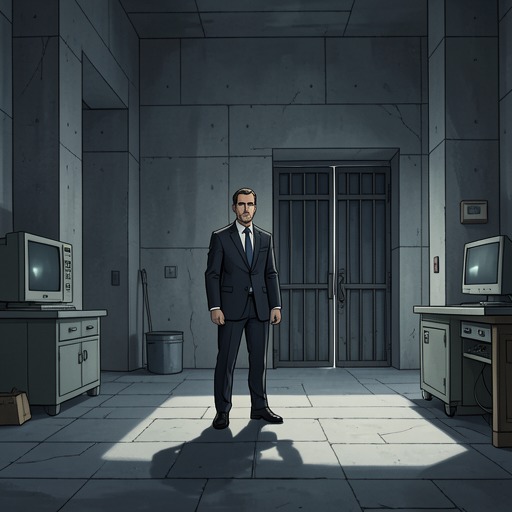
Edward Niedland’s home
The Mystery of The Invisible DogEdward Niedland’s home is both a private residence and an artist’s studio at 329 Lucan Court, directly behind Fenton Prentice’s apartment building. The house is where the Carpathian Hound was stolen, and its close position to Prentice’s home turns an apparently routine burglary into a puzzle of nearby routes, misplaced objects, and mistaken assumptions.
Setting and Spatial Position
The house stands on the next street over from Prentice’s apartment building. The boys reach it not by a direct street approach, but by going down the apartment building’s stairs, crossing its courtyard, and leaving through a back entrance. A narrow passage leads past a laundry and a storeroom, then up a few steps to an alley lined with dustbins, garages, and the backs of buildings facing the neighboring street. From there, 329 Lucan Court is directly behind the apartment house: a square, single-storey frame residence.
That route gives the house a specific place in the neighborhood’s geography. It is close to Prentice’s apartment, but reached through service spaces and the backs of buildings rather than a grand or conspicuous entrance. The arrangement places domestic interiors, an alley, and the adjacent street within a short walk of one another. The boys’ approach follows this back-of-house route to investigate what first appears to be a separate break-in, while the house’s position makes the connection to Prentice immediately concrete.
A Home That Is Also a Studio
When the boys enter, Charles Niedland opens the door and appears haggard. Inside, the living room makes the dual use of the house unmistakable. A skylight has been cut into the ceiling, while the room has no carpets and very little furniture. Drawing tables and an easel share the space with photographs and sketches tacked across the walls, books piled throughout the room, a small television, a sophisticated-looking stereophonic sound system, and a large record collection. It is not presented as a conventional, fully furnished home: work, books, images, and leisure equipment occupy the same interior.
The house also holds the residue of Edward Niedland’s artistic life. Edward kept a small collection there, consisting of his own work and pieces by other artists. After Edward died, Charles removed the works to a safer place. The Carpathian Hound was in the house only by chance, so its presence did not represent the return of Edward’s entire collection or a permanent arrangement. The recent end of Edward’s gallery show had left Charles returning borrowed artworks; his visit to the house involved both that practical task and sorting through his brother’s books.
The Burglary and Charles’s Account
Charles came to the house late one afternoon intending to deliver the Hound to Prentice and spend time sorting Edward’s books. He had arranged to meet Prentice after speaking with him earlier in the day, and arrived when Prentice was expecting the investigators. Charles left the sculpture at the house and went out to eat. When he returned, he saw an intruder through a window and immediately called the police from a neighbor’s phone. Prentice later reproached him for carelessness; Charles preferred to call the episode bad luck.
Charles initially described the break-in as ordinary: the burglar had supposedly used a glass cutter on the kitchen window, reached through the hole, and opened the latch. That explanation accounts for an entry route, but not for the larger chain of events. The police search brought officers into the neighborhood, and the burglar escaped the house with the Hound. Jupiter’s later reconstruction placed the fugitive in St Jude’s Church, where he put on a cape and mitre and posed as a statue while officers searched nearby. The house is therefore the starting point of a flight through adjacent spaces, rather than an isolated crime scene.
The Hound’s Trail and the House’s Significance
The sculpture’s later discovery in a swimming pool extends the trail that begins at 329 Lucan Court. Jupiter explained that the burglar had lowered the Hound to the bottom by a length of gilt cord, which blended into the pool’s blue-and-gold tile pattern. The method allowed the sculpture to be concealed without the burglar entering the water. The Hound’s temporary disappearance thus depended on an object that had been present in the house by chance, then carried away and hidden in a different, ordinary setting.
Edward Niedland’s home matters because it joins the domestic and artistic histories of the Niedland brothers to the investigation’s physical geography. Charles’s efforts to return borrowed art and handle his brother’s books bring the Hound into the house; the burglary removes it; and the nearby streets and church form part of the escape the investigators reconstruct. The contrast between the room’s visible evidence of artistic work and the apparently commonplace method of entry makes the house a fitting first scene for a mystery whose solution depends on looking closely at how objects and people move through familiar spaces.